Engula Bench – Baseline Performance Comparison Report
Document Version: v2.1 Last Updated: 2025-09-19 Maintained by: Engula Performance Engineering Team
Overview
This report presents a baseline performance comparison between Engula 2.1 and Redis 7.2, focusing on throughput and latency across varying value sizes and CPU configurations. The purpose of this benchmark is to quantify Engula’s behavior under standardized, reproducible test conditions.
1. Design Goals and Methodology
1.1 Objectives
To evaluate and compare the Get/Set throughput (QPS) and latency (P50) of Engula 2.1 versus Redis 7.2 under equivalent workloads, across multiple configurations of CPU cores and data sizes.
1.2 Performance Metrics
- QPS (Throughput): Number of requests processed per second
- P50 (Median Latency): Median response time, representing typical-case latency
1.3 Comparison Methodology
- Scope: Single-instance comparison with persistence disabled to focus on in-memory data path and protocol processing performance
- I/O Thread Configurations:
io-threads ∈ {1, 2, 4} - Controlled Parameters: Identical data scale, request distribution, and concurrency model for reproducible results
- Value Sizes Tested: 8B, 32B, 128B, 512B, 1KB, and 2KB
2. Test Environment
2.1 Hardware and Software Configuration
| Component | Specification |
|---|---|
| Instance Type | Alibaba Cloud ECS (ecs.c9i.xlarge, ecs.c7a.4xlarge, ecs.g8y.2xlarge) |
| CPU | 8 vCPUs – 16 vCPUs |
| Memory | 32 GB |
| Operating System | CentOS 7.9 (kernel configured for low-latency workloads) |
Each instance was benchmarked independently under identical network and system configurations to ensure a fair comparison.
3. Benchmark Tool – Engula Bench
All tests were conducted using Engula Bench, a benchmarking framework for Redis-protocol–compatible performance measurements.
For detailed usage instructions and configuration parameters, refer to: 📄 Engula Bench – Baseline Performance Tool Documentation
4. Test Results
4.1 Environment: ecs.c9i.2xlarge
- CPU: Intel® Xeon® Granite Rapids × 8
- Memory: 16 GB
- Operating System: CentOS 7.9

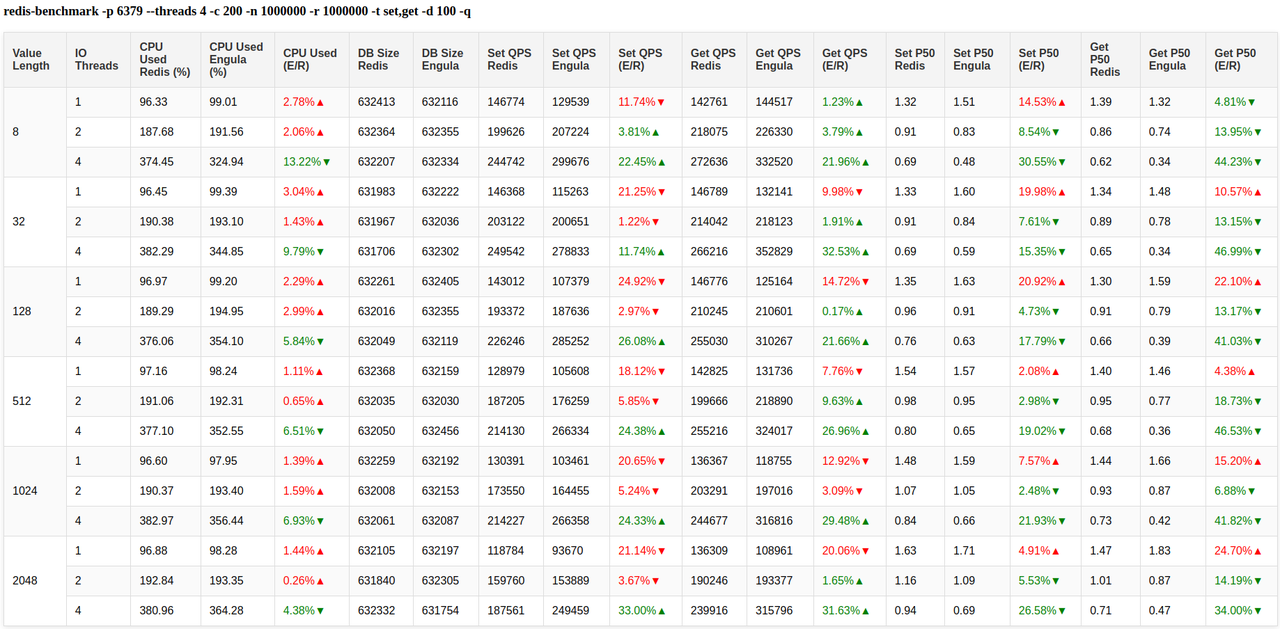
4.2 Environment: ecs.c7a.4xlarge
- CPU: AMD EPYC™ MILAN × 16
- Memory: 32 GB
- Operating System: CentOS 7.9
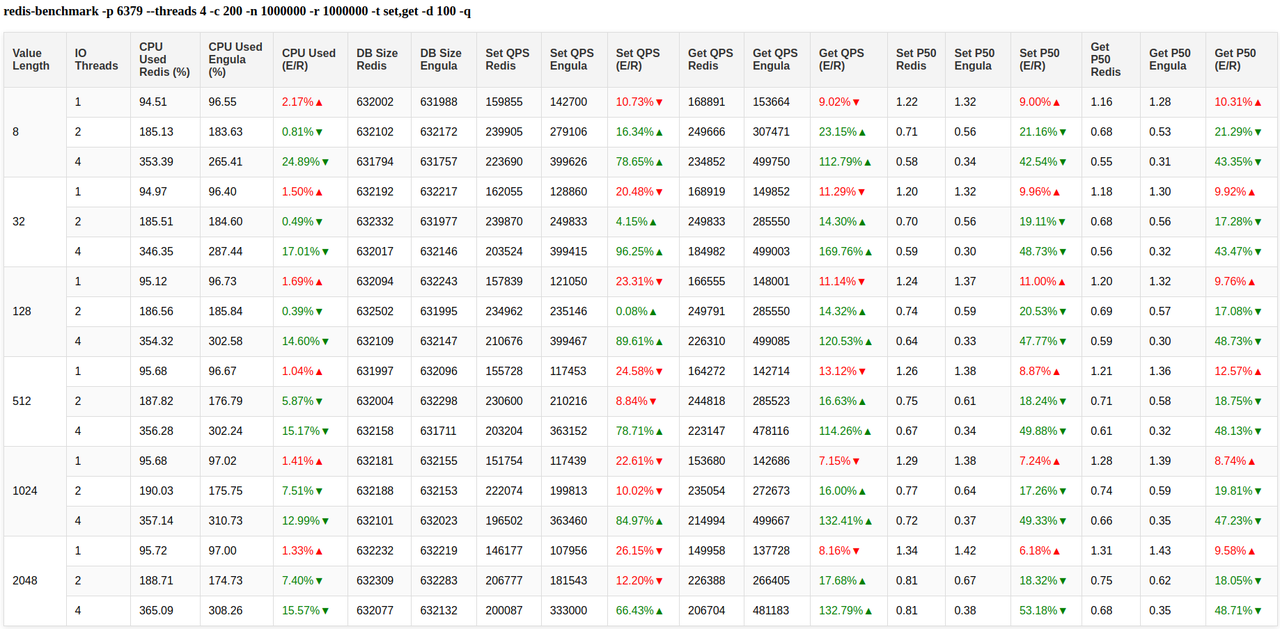
4.3 Environment: ecs.g8y.2xlarge
- CPU: Yitian 710 × 8
- Memory: 32 GB
- Operating System: CentOS 7.9
5. Summary of Findings
Across the tested CPU architectures and workload scales, the benchmarks show the following characteristics:
- Throughput: Under the tested conditions, Engula reaches comparable or higher QPS than Redis 7.2 with the same threading configurations.
- Latency: Engula maintains sub-millisecond P50 latency for the evaluated value sizes.
- Resource Usage: Combined with Engula’s memory compression engine, the results indicate improved memory efficiency while keeping Redis-compatible response times.
Overall, Engula 2.1 behaves as a viable alternative to Redis for in-memory data workloads, providing protocol compatibility with additional options for scaling, efficiency, and configurability across heterogeneous cloud environments.